
Blog
Rear-End Collision Repair on a Luxury Car:What’s Really Going On Behind the Bumper
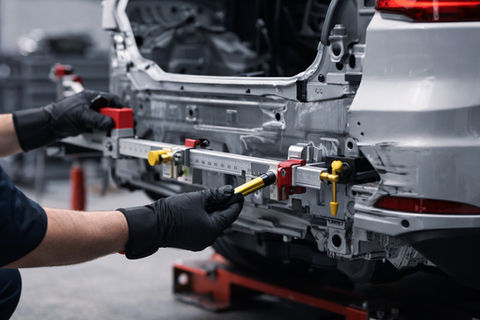
Rear-end collision on your luxury car? Learn what’s really happening behind the bumper—hidden damage, sensors, frame, and paint. Florida guide.
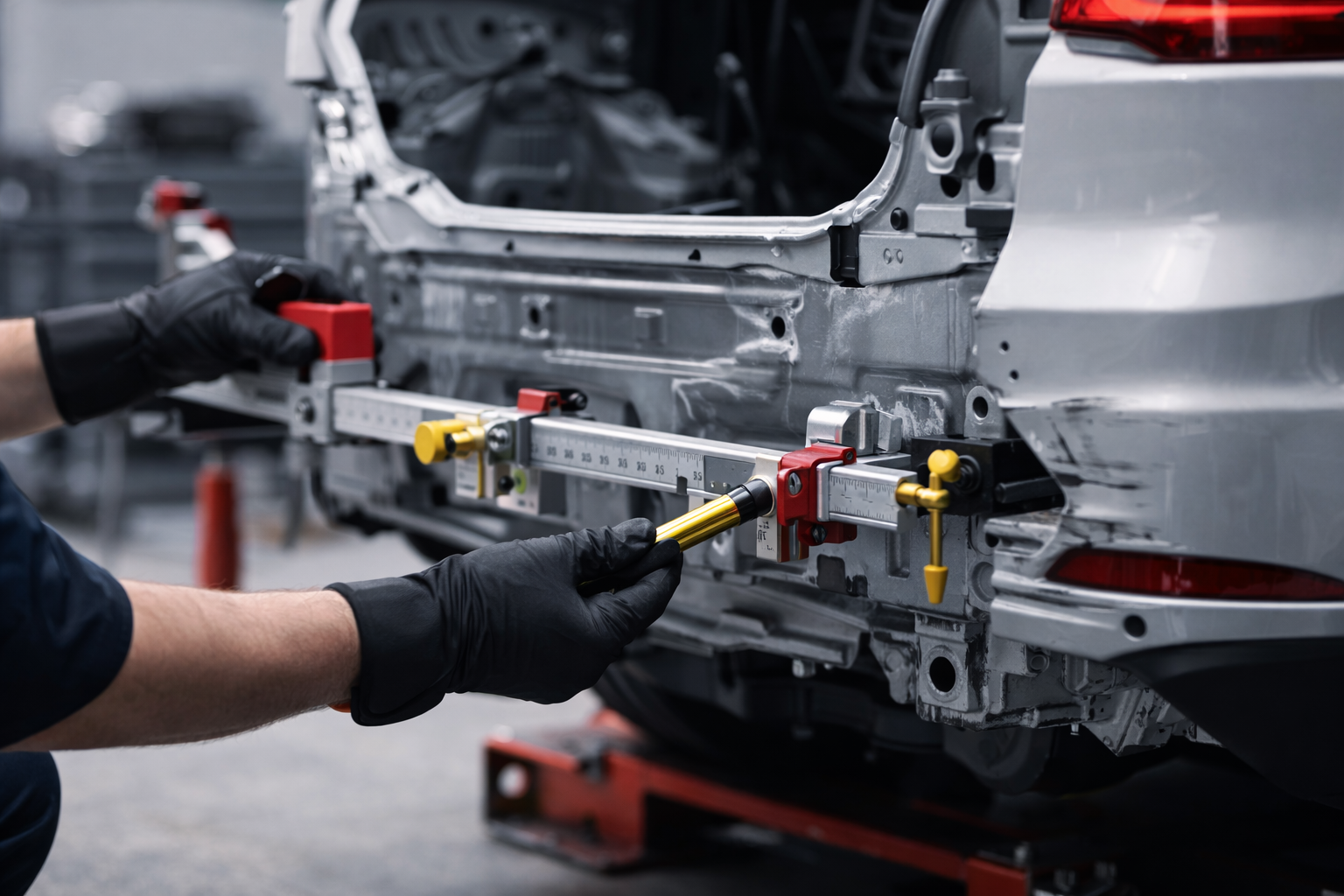
Traffic on I-95 on a Thursday afternoon in South Florida is its own kind of adventure. You’re keeping a reasonable following distance, the air conditioning is doing its best against the July heat, and then — a jolt. Not a serious crash. More of a sharp, jarring bump that snaps your head back and floods you with adrenaline. You pull to the shoulder and walk around to the rear of your vehicle: a BMW 7 Series, a Range Rover, a Porsche Panamera, whatever it is that sits in your garage and represents real money, real care, and real meaning to you.
The bumper cover shows a scuff. Maybe a hairline crack near one corner. The other driver is already telling you it’s nothing, “just cosmetic.” And part of you wants to believe that, because it would make the whole afternoon a lot simpler.
But here’s what years of working on luxury and exotic vehicles teaches you: what you can’t see after a rear-end impact is almost always more significant than what you can. Behind that polished fascia is a system of engineering, technology, and precision materials that responds to collision forces in ways that don’t always announce themselves visually. Hidden damage on a high-end vehicle isn’t rare — it’s the norm.
This post is a straight look at what actually happens behind the bumper of a luxury or exotic vehicle when it takes a rear-end hit. Not to alarm you, but to make sure you walk into the repair process informed, protected, and asking the right questions.
The Bumper Is a System, Not a Single Part
Most people think of the rear bumper as one thing. In reality, on a modern luxury vehicle, it’s a layered assembly of five or six distinct components, each with its own job, its own failure mode, and its own replacement or repair requirements.
Starting from the outside and working inward: the bumper cover, or fascia, is the visible outer shell you see every day. On European luxury sedans it’s typically a flexible thermoplastic. On performance-oriented vehicles like an AMG variant or a Porsche GT model, it may incorporate carbon fiber or a hybrid composite. Behind the fascia sits a foam energy absorber — a block of engineered material designed specifically to compress and deform in a low-speed impact, absorbing kinetic energy before it reaches the structure behind it. Behind that sits the bumper reinforcement beam: a rigid metal or composite bar that spans the vehicle’s rear width and transfers any remaining impact force into the frame rails.
Here’s what matters about this layered design: the foam absorber is meant to sacrifice itself. It compresses completely and permanently in even a moderate impact, which means it can look completely intact from the outside while being structurally useless. You can’t evaluate it through the fascia. You have to physically remove the cover to see it.
Now add to this the electronics. Most luxury vehicles produced in the last several years have four to eight parking sensors flush-mounted into the rear fascia. A backup camera — on many models now integrated into a 360-degree surround-view system — is housed in or near the lower bumper or trunk lid trim. Higher-end vehicles carry rear radar modules behind the bumper cover, feeding data to adaptive cruise control, blind spot monitoring, and rear cross-traffic alert systems. And on performance vehicles, there are often active aerodynamic elements — diffusers, vents, electronically-actuated components — that are tuned to specific airflow parameters at highway speed.
A collision that moves, cracks, or subtly repositions any of these components creates a problem that has nothing to do with aesthetics. The car may look fine. The systems underneath may not be.
⚠️ Florida Climate Note
Florida’s heat and humidity are particularly unforgiving to components that sustain micro-fractures in a collision. Plastic sensor housings, electrical connectors, and composite materials that develop hairline stress cracks under impact can degrade faster in high-heat, high-UV environments. What seems insignificant in October can become a real problem by March.
How Impact Energy Actually Travels Through Your Vehicle
When another car strikes yours from behind, the kinetic energy of that collision has to go somewhere. Modern vehicles are engineered to direct that energy in a specific, predictable path — one designed to protect occupants. Understanding that path explains why damage in a rear-end collision is so often invisible from the outside.
The foam absorber takes the first wave of force and compresses. If the impact is within its capacity, it does its job, the fascia remains intact, and from the outside everything looks fine. But if the energy exceeds the absorber’s capacity — or if the absorber has already been compromised in a prior event — that force moves on to the bumper beam. The beam may flex, deform, or crack. A deformed beam doesn’t just fail to protect in a future impact; it can pull on mounting points and create subtle misalignment in the trunk, hatch, or surrounding panels that owners notice as uneven gaps or a door that doesn’t close quite right.
If the impact is significant enough that energy reaches the frame rails, you’re now looking at crumple zone damage. This is not a defect in your vehicle — it’s the system working as intended. The rails are engineered to compress in a controlled way, directing energy away from the passenger compartment. But a compressed rail must be properly measured, assessed, and either corrected or replaced. It cannot simply be pushed back into approximate shape. Frame rail damage that goes unaddressed compromises the car’s structural performance in any future collision.
On vehicles with aluminum-intensive construction — the Jaguar XJ, Audi A8, BMW 7 Series, most modern Bentleys and Land Rover variants — frame repair is a more technically demanding process than on conventional steel structures. Aluminum behaves differently under stress, work-hardens differently, and requires specific equipment and techniques to repair correctly. A shop without experience in luxury vehicle construction is not the right place for this work.
Finally, consider the secondary effects as impact energy radiates outward through mounting points. This is where parking sensor housings crack invisibly. This is where a backup camera shifts two or three millimeters from its factory position. This is where a radar module moves just enough to affect its detection angle. These effects often don’t surface immediately — they reveal themselves over days or weeks of driving, long after a hasty repair has closed the insurance file.
“It Looks Fine” — Why That’s the Most Dangerous Conclusion You Can Reach
We hear this phrase regularly, and we understand why. It’s human nature to assess by sight. And for most everyday items, visual inspection is a perfectly reasonable approach. But on a luxury or exotic vehicle that has sustained a rear-end impact, a visual-only assessment is genuinely insufficient — not because we’re being dramatic about it, but because of how these cars are engineered.
The crumple zones and energy absorbers in your vehicle are designed to be invisible in their operation. That’s the point. They protect you without drawing attention to themselves. A foam absorber that has fully collapsed looks, from the outside, identical to one that hasn’t been touched. The fascia may have a small scuff or no damage at all. The system that was supposed to protect you in your next accident has quietly failed, and there’s no warning light for it.
Sensor displacement follows a similar pattern. A parking sensor or radar module that was moved slightly in the impact may continue to function for a period of time. But sensors that operate outside their factory-calibrated position will either read inaccurately or fail entirely — often gradually, over weeks, as temperature cycling, humidity, and road vibration compound the original displacement. Florida drivers who log highway miles in 90-degree heat are accelerating this process. By the time the system fails visibly, the connection to the original collision can be difficult to establish — which matters for warranty and insurance purposes.
Panel alignment is another tell. On a luxury vehicle, factory panel gaps are measured in millimeters and held to tight tolerances. After a rear-end collision that affects the underlying structure, the trunk lid, rear quarter panels, or bumper fascia may show subtle gap inconsistencies. On a standard vehicle, most people wouldn’t notice. On a well-maintained luxury or exotic vehicle, enthusiasts and experienced technicians spot it immediately. More importantly, it’s a visible indicator of what’s happening beneath.
And then there’s resale value. A vehicle history report will show the collision regardless of how the repair is handled. What matters — enormously — is whether the repair was done properly and whether it’s documented correctly. A well-documented, thorough repair performed by a facility experienced with luxury vehicles is a very different story than an underdocumented quick fix. Buyers, dealers, and auction houses know the difference, and so will your eventual sale price.
💡 What to Watch For
After any rear-end collision, pay attention to these in the days following: uneven trunk gaps or a lid that doesn’t close with the same resistance as before; backup camera image that appears shifted or angled differently; parking sensor alerts that seem inconsistent or absent; blind spot or cross-traffic warnings that behave differently than before the impact. Any of these warrant a professional inspection.
ADAS: The Safety Technology You Can’t Afford to Overlook
Advanced Driver Assistance Systems — ADAS — is the umbrella term for the suite of technologies that have become standard on virtually every luxury vehicle built in the past several years. Adaptive cruise control, blind spot monitoring, rear cross-traffic alert, lane departure warning, and automatic emergency braking are all part of this ecosystem. They are also, without exception, dependent on sensors and cameras being positioned within precise factory tolerances.
A rear-end collision that affects the bumper area can disturb any of the ADAS components located there — and on most modern luxury vehicles, that’s several of them. Rear parking sensors, the backup camera, rear-facing radar modules, and sometimes sonar arrays for park assist are all clustered in or near the rear fascia. A repair that restores the visual appearance of the bumper without addressing the calibration and positioning of these components is an incomplete repair, full stop.
What makes this more complicated is that ADAS calibration requires more than just physical inspection. Many systems require specific software tools, manufacturer-approved calibration targets placed at precise distances from the vehicle, and trained technicians who understand the calibration procedure for that specific make and model. A shop that does excellent body work but lacks this equipment is not able to fully restore your vehicle’s safety systems. It’s worth asking, directly and specifically, how any prospective repair facility handles ADAS components. If the answer is vague, that’s useful information.
Not every rear-end collision will require full ADAS recalibration — the scope depends on the impact, what components were affected, and the vehicle’s specific configuration. But the only way to know is through a proper inspection. Acting on assumption in either direction — assuming everything is fine, or assuming everything needs replacement — is less useful than a careful, documented assessment.
Paint Blending: Where Florida’s Sun Exposes Every Shortcut
Repainting a rear bumper fascia on a luxury or exotic vehicle is not the same process as repainting one on a standard sedan. The materials are different, the paint systems are different, and the finishing expectations are different. Getting it right requires specific knowledge, equipment, and patience.
Many luxury manufacturers use multi-stage paint systems — sometimes three, four, or five sequential layers of color, pearl, metallic, and clear coat — that aren’t available as off-the-shelf mixes. Brands like Bentley, Rolls-Royce, Ferrari, and Lamborghini often use proprietary formulations. Even for more accessible luxury marques, achieving a color match frequently requires spectrophotometer analysis — a device that reads the existing paint at multiple points on the vehicle and generates a mixing formula. Without this step, color match is essentially a guess.
Metallic and pearl finishes introduce another variable: the orientation of the metallic flake or pearl particles in the factory paint was established during the original application process. Respraying a panel without carefully controlling spray angle, pressure, and flash time can result in “metaflop” — a finish that appears to match in one light condition and clearly doesn’t in another. This is immediately apparent under direct sunlight, which, in Florida, is not in short supply.
Blending — the process of feathering new paint into adjacent panels so the color transition is seamless — is particularly challenging on rear quarters. These are large, curved surfaces with complex geometry. A blend line that looks acceptable inside a shop can become visible under Florida’s intense midday sun at certain angles. This isn’t a theoretical concern; it’s a practical one that anyone who drives a dark-colored luxury vehicle in South Florida has probably noticed on someone else’s car at some point.
An OEM-approach refinishing process on a luxury fascia involves color mixing with spectrophotometer support, multi-stage application with proper flash times between coats, temperature-controlled curing (either via infrared lamps or a heated spray booth), and final polish and paint correction to match factory gloss levels. It takes time. It requires equipment. And it’s the only way to produce a result that looks right six months from now, not just the day you pick up the car.
Documentation: Your Vehicle’s Repair History Is an Asset
Every repair has a paper trail, and that paper trail has value — both for your peace of mind and for your vehicle’s market position. A thorough, well-organized repair file tells a story: this vehicle was in a collision, the damage was assessed properly, the right parts were used, the safety systems were addressed, and the repair meets the standard the vehicle deserves.
For luxury and exotic vehicle owners, this documentation becomes particularly important at the point of sale. A buyer or dealer reviewing a Carfax report that shows a collision has three possible interpretations of your vehicle: it was fixed properly, it was fixed poorly, or they can’t tell because the documentation doesn’t say enough. Only one of those outcomes serves your interests. Detailed repair records that specify OEM parts usage, ADAS calibration results, frame measurement data if applicable, and the paint process applied give a prospective buyer the confidence to value the vehicle appropriately rather than penalizing it by default.
On the insurance side, documentation also matters. If the full extent of damage isn’t known at the time of the initial estimate — which is common, because some damage is only visible once the bumper is removed and the structure is accessible — a supplemental claim may be necessary. Having a repair facility that understands this process and can communicate effectively with adjusters on your behalf is a meaningful advantage. In Florida, vehicle owners generally have the right to choose their own repair facility, which means you don’t have to default to the insurer’s preferred network if it isn’t the right fit for your vehicle.
A Real-World Scenario: When the Quick Fix Wasn’t Enough
Consider this situation: the owner of a European luxury SUV gets rear-ended in a parking structure near his office in Florida. The impact is brief and sharp — a crack in the lower corner of the bumper cover and a scuff across the center. A shop near the parking structure offers a two-day turnaround: new bumper cover, repaint, done. The estimate is reasonable.
Something gives him pause. He brings the vehicle to a facility that specializes in luxury vehicles for a second look.
The inspection turns up the following: the foam energy absorber behind the fascia has collapsed on the driver’s side. One of the rear parking sensors has a cracked housing that isn’t visible from outside the vehicle. The bumper reinforcement beam has a hairline deformation at the left mounting point. And the rear radar module — which feeds his blind spot monitoring and rear cross-traffic alert — has shifted approximately four millimeters from its factory position. None of this is visible with the bumper cover in place.
The proper repair involves replacement of the absorber and radar module, correction of the beam mounting point, sensor replacement and system calibration, and full refinishing of the fascia with proper OEM paint matching. It takes longer and costs more than the original estimate. It also results in a vehicle that performs the way it’s supposed to, with documentation that reflects what was done and why.
Six months later, when he trades the vehicle in, the dealership reviews the repair history. The documentation shows a collision that was handled thoroughly. The trade value reflects a vehicle that was cared for correctly. That outcome doesn’t happen by accident — it happens because someone asked the right questions before authorizing the repair.
Quick Checklist: What to Do After a Rear-End Collision
Keep this handy. The steps that matter most tend to be the ones easiest to skip when you’re dealing with the stress of a fresh accident.
Photograph everything at the scene: both vehicles, damage close-up and wide, plate numbers, road conditions, weather.
Exchange full information: insurance, driver’s license, contact details. Get the other party’s insurance card, not just a verbal policy number.
Report the incident to your insurer promptly, even if fault is unclear. Delayed reporting can complicate claims.
Do not agree to informal settlements or skip the formal claim process. “I’ll just pay you directly” is not in your interest on a luxury vehicle.
Choose your repair facility before the insurer directs you elsewhere. In Florida, you generally have the right to choose your own shop.
Request a structural and electronic inspection, not just a visual assessment. Insist on seeing the damage report once the bumper cover is removed.
Ask specifically about ADAS calibration requirements for your vehicle make and model.
Confirm whether OEM or alternative parts are planned for your repair, and ask for the reasoning.
Request full repair documentation: estimate, final invoice, calibration records, parts sourcing, paint codes.
Ask about courtesy loaner availability and deductible assistance options — options may be available depending on circumstances; ask our team for details.
Frequently Asked Questions
1. My bumper only has a small crack. Does it really need a full inspection?
Yes, particularly on a luxury or exotic vehicle. The exterior crack tells you very little about what’s happened behind it. The foam absorber, reinforcement beam, and sensor housings are all behind the fascia and can sustain significant damage with no external evidence. A proper inspection requires physically removing the bumper cover to assess what’s beneath. The inspection itself may confirm minor damage — but that’s a conclusion to reach after looking, not before.
2. Will my insurance cover OEM parts on a luxury vehicle?
It depends on your specific policy. Standard policies often allow “like kind and quality” parts, which can include non-OEM alternatives. However, many policies — particularly those with OEM endorsements — may provide for original manufacturer parts, especially on newer vehicles. It’s worth reviewing your policy and discussing parts preferences with your repair facility, who can often assist in communicating with your adjuster.
3. How do I know if my ADAS systems need recalibration after a rear-end hit?
You often cannot tell from the outside, and warning lights may or may not appear. The safest approach after any impact that affected the rear bumper area is to have the relevant systems evaluated by a technician with the manufacturer-appropriate diagnostic equipment. Assuming everything is fine without checking is a risk, particularly on systems like blind spot monitoring and cross-traffic alert that you rely on in daily driving.
4. Can I choose my own repair shop in Florida?
Generally, yes. Florida law provides vehicle owners with the right to choose where their vehicle is repaired. An insurer may suggest a preferred facility or a direct repair program shop, but you are typically not obligated to use it. For luxury and exotic vehicles in particular, where the shop’s experience with your specific make and model is a meaningful factor, exercising that right is worth considering.
5. How does rear-end collision damage affect resale value?
Any collision that appears in a vehicle history report will influence how prospective buyers interpret your vehicle’s history. The degree of impact depends significantly on the quality and completeness of the repair documentation. A repair performed to a high standard, with proper parts and documented ADAS calibration, is a very different proposition to a buyer than an underdocumented repair of unknown scope. Protecting your documentation from the beginning protects your eventual sale price.
6. What is paint blending, and why does it matter on my car?
Paint blending is the technique of feathering a newly refinished area into adjacent panels so the color and finish transition is undetectable. On standard vehicles with simple single-stage paint, this is relatively straightforward. On luxury vehicles with multi-stage metallic, pearl, or proprietary finishes, it requires precise color mixing, proper application technique, and controlled curing. Florida’s intense direct sunlight is an unforgiving environment for blends that haven’t been executed correctly — differences that aren’t visible in a shaded shop can become obvious outdoors.
7. How long should a rear-end repair take on a luxury vehicle?
The honest answer: it depends on the scope. A straightforward fascia replacement with no structural or electronic involvement may take a few days. A more involved repair — structural correction, OEM parts sourcing, ADAS calibration, multi-stage refinishing — will take longer. European and exotic OEM parts often have longer lead times than domestic alternatives. A facility that gives you an accurate, honest timeline based on what’s actually needed is more valuable than one that prioritizes speed over thoroughness.
8. My rear-end collision happened during a Florida rainstorm. Does weather affect the damage assessment?
The collision mechanics are the same regardless of weather conditions. However, if any damage compromised seals, panel gaps, or sensor housings, water intrusion is a meaningful concern in Florida’s climate. Moisture inside sensor housings or electrical connectors can accelerate corrosion and cause gradual system failures over weeks or months following a collision. It’s worth specifically mentioning weather conditions at the time of impact during your inspection so the technician can pay particular attention to sealing and electrical components.
Ready to Have Your Vehicle Properly Assessed?
If your luxury or exotic vehicle has sustained a rear-end collision — whether it appears minor or you’re already sensing something is off — the most important step is a thorough inspection before any decisions are made about repair scope, parts, or insurance claims.
At Car Geeks Collision, our team works specifically with luxury and exotic vehicles. That means we understand the structural engineering, the electronics, the paint systems, and the documentation requirements that make these vehicles different from standard repairs. We’ll give you a clear, honest picture of what your vehicle actually needs — nothing more, nothing less.
Reach out when you’re ready. There’s no pressure, no rush, and no obligation. Just a straightforward conversation about your vehicle and how we can help.
Why Car Geeks Collision
Specialized diagnostics and inspection approach for high-end vehicles
A focus on preventive maintenance and correct repair processes
Support for owners who value performance, safety, and long-term value
Car Geeks Collision offers courtesy towing, courtesy loaner vehicles, deductible assistance, and financing available.Contact: +1 786-786-1387Website: https://www.cargeekscollision.com